

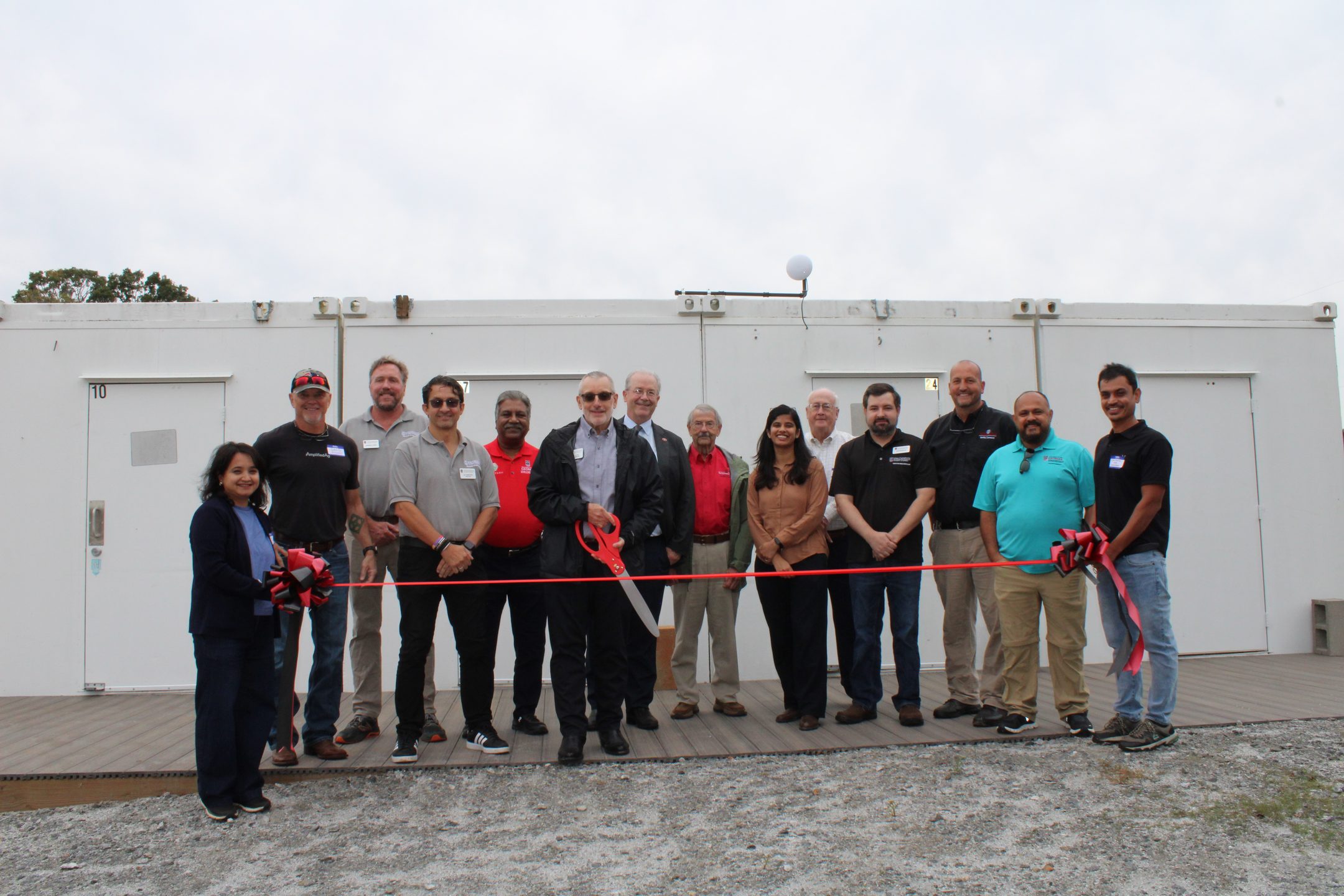
Over the last several years, the interest in and research for Controlled Environment Agriculture (CEA) – using technology to modify environmental conditions of breeding crops- has steadily increased. In response, the University of Georgia has built a CEA team to contribute to the ever-growing industry as well as constructing two new facilities- a greenhouse and a container research vessel- on the UGA Griffin campus. A ribbon cutting ceremony was held on October 9, which was dubbed CEA Day at UGA Griffin. UGA administration, faculty and staff attended the event along with industry professionals to view the new structures.
The CEA greenhouse on the Griffin campus is the first of its kind for UGA. It is a 90×30 structure that allows for automation in supplemental lighting, irrigation as well as heating and cooling. The structure is shared between horticulture and entomology.
Jeffrey Dean, Assistant Provost and Campus Director of UGA Griffin, opened the day by thanking those who have been instrumental in the process of building the facilities. He thanked former UGA Provost Jack Hu, for obtaining funding for the greenhouse and former UGA Griffin Facilities Manager Dale Hess for overseeing the project. Dean concluded his time by thanking his late friend and colleague Mark van Iersel who spent many years on the Athens campus training students in greenhouse management, automated sensor-based irrigation, and LED lighting energy.
“It was his energy and creative ideas that really set the stage for us getting into this,” said Dean.
Nick Place, Dean of the College of Agricultural and Environmental Sciences, told the crowd how exciting this is for CEA research and thanked those who made it possible.
“This is a very special day and something we have been working on for sometime,” said Place. “We are very grateful for all the growers and industry representatives, all of our researchers, extension professionals, students and government partners. And for all of ag leaders from across our great state of Georgia and beyond that helped make this happen.”
Place went on to thank the industry professionals in the crowd, stating their presence reflects the growing momentum in controlled environment agriculture and the tremendous opportunities it presents to the future of the industry. He added that agriculture continues to evolve in response to changing consumer demands, challenges, labor concerns, environmental pressures, and a need for greater production and efficiency.
“Controlled environment agriculture is emerging as one of the most promising tools available to help our growers meet these challenges while creating opportunities that are profitable and sustainable for food production,” said Place. “Whether it be through greenhouse production, hydroponics, vertical farming, container farming systems or technology, controlled environment agriculture is defining where and how food can be grown.”
The CEA team at UGA consists of five members of a cross-disciplinary team who collaborate to advance plant growth, crop resilience, and innovation in controlled environment agriculture. The team, which is located across the Athens and Griffin campuses, includes Dr. Rhuanito Ferrarezi, Professor of Horticulture (crop physiology and root-zone management); Dr. Andrew Ogden, Assistant Professor of Horticulture / Plant Breeder; Dr. Erich Schoeller, Assistant Professor of Entomology (controlled-environment pest management); Dr. Zhihang Song, Assistant Professor of Horticulture (phenomics, imagery sensors, machine learning, and robotics) and Dr. Ruchika Kashyap, Assistant Professor of Plant Pathology and UGA Extension Specialist (disease management in CEA systems).
Both Ogden and Schoeller are based on the Griffin campus.
Ogden spoke to the crowd about the benefits of using CEA, but also for the need to diversify and expand the types of crops that are grown in those environments.
“With CEA we can really improve our crop quality and yields and hopefully profitability for growers. The industry has been growing rapidly, but we don’t think of it as a fix-all or something that will replace traditional agriculture. Rather it would exist side by side with it,” said Ogden. “We need new crops (in CEA). We have an industry largely driven by leafy greens, tomatoes and cucumbers, but we need to explore what else we can grow in these systems and become profitable.”
He noted while there are challenges with CEA such as high start up costs and operational costs needed for heating, cooling and supplemental lighting, there are ways for companies to start on a smaller scale and he is excited for where it is going and working with CEA industries.
Those in attendance heard were able to tour the greenhouse and container research vessel while at CEA Day. Industry professionals also had the opportunity to meet with the researchers to share their needs and concerns about the industry. The event was sponsored by Bright Farms, Amplified Ag and the Georgia Center of Innovation.
To learn more about the research being done in CEA visit the link below.